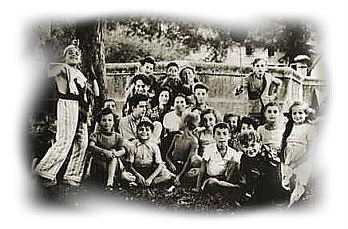
In
1944, the Nazis from Lyon sent two vans to the French
village of Izieu. Their Mission: to exterminate the
children of an orphanage known as La Maison d'Izieu.
The
sleepy village of Izieu lay overlooking the Rhone river
between Lyon and Chambery in central France. Refugees from
Herault were the first arrivals at the Children's home and
their Jewish identity was kept secret by the staff. The
children, aged between four and seventeen, felt safe and
secure, supervised by seven adults. Often one of the young
boys entertained his companions by making movies,
paintings on transparent paper and scrolled past a lighted
box.
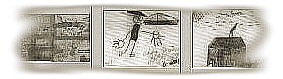
The
Children's Home was a perfect idyll and the Jewish
children led a happy life during World War 2 with plenty of time for playing,
drawing and painting, as these sketches show, made by the
Izieu children.
However,
on the morning of April 6, 1944, as they all settled down
in the refectory to drink hot chocolate, three vehicles,
two of which were lorries, pulled up in front of the home.
The Gestapo, led by the 'Butcher of Lyon' Klaus Barbie,
entered the home and forcibly removed the forty four
children and their seven supervisors, throwing the crying
and terrified children on to the trucks like sacks of
potatoes.
As
a witness later recalled: 'I was on my way down the
stairs when my sister shouted to me: it's the Germans,
save yourself! I jumped out the window. I hid myself in a
bush in the garden. I heard the cries of the children that
were being kidnapped and I heard the shouts of the Nazis
who were carrying them away...'
Following
the raid on their home in Izieu, the children were shipped
directly to the 'collection center' in Drancy, then put on
the first available train towards the deathcamps in the
East. Forty-two children and five adults were gassed in
the extermination camp of Auschwitz. Two of the oldest
children and Miron Zlatin, the superintendent, ended up in
Tallin in Estonia and were put to death by a firing squad.
Of
the forty-four children kidnapped by the Nazis in Izieu,
not a single one survived. Of the supervisors there was
one sole survivor, twenty-seven year old Lea Feldblum.
When the children from Izieu arrived in Auschwitz on April
15, 1944, Léa led the column of children to the selection
point. When she informed the SS that these children were
from a home, she was ruthlessly separated from them and
sent to the prisoners' camp.
One
survivor of Auschwitz
revealed during Klaus Barbie's trial what happened to the
children: 'I asked myself where were the children who
arrived with us? In the camp there wasn't a single child
to be seen. Then those who had been there for a while
informed us of the reality. 'You see that chimney, the one
smoke never stops coming out of .. you smell
that odor of burned flesh ...'
One
of the children of La Maison d'Izieu was
eleven-year-old Liliane Gerenstein. Lilliane and her brother were
sent to their deaths a few days after she wrote this
letter to God:
God?
How good You are, how kind and if one had to count the
number of goodnesses and kindnesses You have done, one
would never finish.
God? It is You who command. It is You who are justice, it
is You who reward the good and punish the evil.
God? It is thanks to You that I had a beautiful life
before, that I was spoiled, that I had lovely things
that others do not have.
God? After that, I ask You one thing only: Make my
parents come back, my poor parents protect them (even more
than You protect me) so that I can see them again as soon
as possible.
Make them come back again. Ah! I had such a good mother
and such a good father! I have such faith in You and I
thank You in advance.
The children's father, Chapse, miraculously survived the
Holocaust and emigrated to the United States.
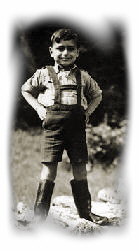
Georges Halpern
Another
child of Izieu was eight-year-old Georges Halpern,
born Oct. 30, 1935 in Vienna. After the war a letter to
his parents was found - the little boy wrote:
Chere
Maman, I send you 10000000000 kisses your son who loves
you very much. There are big mountains and the village is
very pretty. There are a lot of farms and we look for
blackberries and raspberries and white mulberries. I hug
you with all my heart. Georgy.
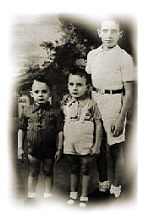
Jacques and his brothers
Jacques
Benguigui was born on April 13, 1931, in Oran,
Algeria, but the family moved to Marseilles, France,
shortly before WW2. His mother was deported to Auschwitz
in Poland on July 31, 1943, and Jacques and his two
younger brothers, Richard, six years old, and
Jean-Claude, who was five, were sent to be sheltered in
the Children's home in Izieu.
While
in Izieu Jacques wrote a letter to his mother:
O
Maman, my dear Maman, I know how much you've suffered on
my account and on this happy occasion of Mother's Day I
send you from afar my best wishes from the bottom of my
little heart. So far from you, darling Maman, I've done
everything I could to make you happy: when you've sent
packages, I've shared them with the children who have no
parents. Maman, my dear Maman, I leave you with hugs and
kisses. Your son who adores you. Jacques
After
the Nazi raid Klaus Barbie sent a telex to Gestapo
headquarters in Paris declaring that the children's colony
at Izieu had been removed and arrangements made for the
deportation of its residents. The full text, which
contains mistakes about the children's ages and apparently
counted three of the oldest children among the adults
arrested, reads:
"This
morning, the Jewish children's home, Children's Colony, at
Izieu has been removed. 41 children in all, aged 3 to 13,
have been captured. Beyond that, the arrest of all the
Jewish personnel has taken place, namely 10 individuals,
among them 5 women. It was not possible to secure any
money or other valuables. Transportation to Drancy will
take place on 4/7/44. Signed Klaus Barbie."