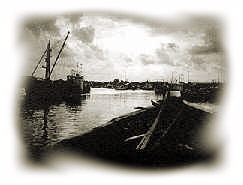
Gilleleje
Gilleleje,
one of the larger fishing harbours, lies at the northernmost point
of the island of Zealand with train connections to Copenhagen. About
one fifth of the Danish Jews escaped to Sweden via this village.
Fishing boats as well as coastal freighters from the harbour took
part. Jews were familiar with Gilleleje from summer holidays in the
country and came to the area in droves. A committee of local people
were quick to initiate rescue aid, even before representatives for
the rescue groups in Copenhagen arrived. Many were needed to help
find hiding places and food.

Danish fishermen saving Jews
One
of the survivors, Leif Wassermann, was only five years old when his
family, including his parents, grandparents and younger sister, fled
to their coastal summer home in Gilleleje. He later recalled how his
father carried him down into the dark hull of the boat in the middle
of the night, but he remembered the hushed voices, the cramped
feeling as people crowded inside and the rotten smell of fish. They
were rescued by Henny Sondig, the 19-year-old daughter of the boat
manager, and the four-man crew of the the 20-ton lighthouse tender,
named the Gerda III.
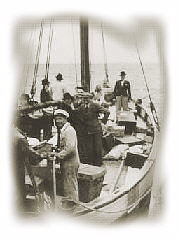
`We
stayed very low on the floor. We heard there were German patrols
outside. We saw flashlights going through the windows,´
Wassermann recalled. Although the Gerda III was regularly boarded by
German soldiers, the refugees were never discovered. The boat made
more than a dozen trips with groups of five to 20 people crammed
inside the hull - thus saving many Jewish families from
annihilation.Leif Wassermann and his family were not able to return
to their homeland until May 5, 1945, when Denmark was liberated.
Years later he was appointed vice consul and commercial attache of
the Danish government in New York.
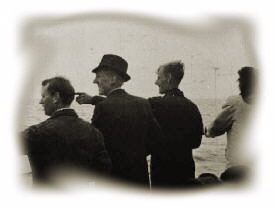
Danish Jews reached safety ..
Over
the course of a few days, more than 7,000 Danish Jews reached safety
in Sweden. Only 481 were captured and sent to the KZ camp Theresienstadt. Conditions there were hard, but Theresienstadt was
not a death camp. And the Danish acts of bravery did not end with
those dramatic weeks in the fall of 1943. Danes continued to protect
the unfortunate Jews whom the Germans were able to capture.
Danish officials repeatedly requested permission to inspect the camp
and as a consequence of the persistent Danish interest in the
deported Jews, none was sent to
Auschwitz. In June 1944, at the
insistence of the Danish leadership, the Danish Red Cross inspected
Theresienstadt to ascertain the condition of their Jewish
compatriots.
The
Danes convinced Adolf Eichmann via Werner Best to keep
the Jews from Denmark away from Poland and the extermination camps.
Best
was interested in improving relations with the Danish authorities in
light of the events in October. Eichmann was presumably hoping to
present an idealized propaganda image to conceal the fact of mass
genocide, which by 1943 had cost the lives of 3 million Jews.
Almost
all of the Danish Jews in the camp survived through the solicitude
and support of the Danish civil service and church organizations.
Month after month, the Danes sent over 700 packages of clothing,
food and vitamins to the Jews in the camp. At
the end of the war, fifty-one of the Danish Jews had died in
Theresienstadt of natural causes.