


Monumental art by Bjørn Nørgaard
"Remember to call Benny on Tuesday…"
by Birgitte Eskildsen
The opening of the new trafficcenter in Vejle has drawn special attention to the city in the way of Bjørn Nørgaards map of monumental art. The artistic turningpoint of the trafficcenter "Jacob´s Vision", that shoots 8.5m in the air, marks a natural climax in the career of this remarkable artist, who´s reputation goes from the socialist horseslaugtherer to the monarchist tapestry-designer.
The Vejle-stone is part of the largest stone ever in Denmark, and when it was cleaved in a Sweedish quarry it was immediately stipulated, that only Bjørn Nørgaard was allowed to work on it; a worthy assignment for this expert artist, because now the rough and tough material is turned into a remarkable statement in peoples lives. All the travellers, who visit the railwaystation in Vejle, will almost immediately want to form an opinion of the imposing stone that come upon them with its many motifs and symbols, and although departing or arriving at your final destination, art leaves the spectator reflectant.
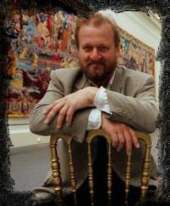
Bjørn Nørgaard
The inspiration for the stone was allready there when the final placing was decided, since the swarming traffic of people in busses and trains, travelling in and out of life, made Bjørn Nørgaard think in biblical terms – on Jacob who has a vision of God´s angels go up and down a ladder to Heaven – "Jacob´s Ladder". This interpretation makes us aware of the journey from a dream to reality, of peoples´dreams and their struggle to reach the purpose of their dreams; a journey both physically and mentally. Another religious motiv on the stone is the story from the New Testament about Jesus and his twelve disciples around the communion table, but one of the disciples is leaving the table; Judas…? The stone is full of motifs you can hardly understand, but maybe this is the essence of our dreams that we can take nothing for granted, we have to come to our own decisions…
Bjørn Nørgaards drafts and models for the ornamentation of the stone also shows how he is able to travel through time and places while he is working. In an artistic handwriting across the sketches for the figures on the south-east side of the stone you come across a short notice "…remember to call Benny on Tuesday.." The mess of thoughts, perhaps started off with the interpretation of the religious motifs, is brought back to order due to the need of actual presence: Remember, to call Benny..!
The Sweedish stone that came from a granite quarry in 1986 also faced a serious journey before part of it finally came to Vejle. The original stone weighed 90 tons which is more than the capability of the Danish rails so when they collapsed the stone was cleaved into two minor stones, 30 tons for Vejle and 60 tons for the German city Kiel. Maybe Bjørn Nørgaard already swor an oath here to ensure the journey of the two stones and the idea of the motifs for the stone in Vejle was born.
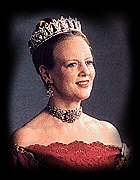
Bjørn Nørgaard is already familiar with the journey from Sweden to Denmark as this particular motif appears in another monumental work of his, the 11 tapestries for our Queen Margrethe´s 60 birthday in the year 2000. The tapestries that are being finished in Paris right now shows the Danish history from the viking period of time up till modern time, designed and masterly constructed by Bjørn Nørgaard. The ninth of the eleven tapestries is "The Younger Glücksborgere" and here you see our own Queenmother Queen Ingrid, who left Sweden and came to Denmark after marrying Christian Frederik Franz Michael Carl Valdemar Georg, better known as Frederik IX who became king in 1947 after his father King Christian X died. 1999 is King Frederik IX´s 100th anniversary, and the late King would no doubt be very proud if he could see himself and his beloved family depicted in the Nørgaard tapestries in the Great Hall in Christiansborg Castle in the new millenium. The new tapestries have a long journey ahead of them before they reach their final destination, since they are to be exhibited in Paris at the Palais du Luxembourg and in the museum "Fredericianum" in Kiel before the journey ends "at home" in Christiansborg Castle in Copenhagen.
Bjørn Nørgaard is known for his many ways of using the same motif adjusted to his current work of art and thus one of his central motifs in the first tapestry "The Viking Period" our national birthcertificate, the Jelling stone, re-appears in an inscription above the cast iron base for the new work of art in Vejle. The inscription reads: I BJØRN MADE TOGETHER WITH HENRIK THIS STONE EJVIND HELPED LITTLE JAN CUT IT AT STONE MASON FLEMMINGS 1998 THE STONE IS EXECUTED WITH DSB VEJLE MUNICIPALITY. In exactly the same way King Harald proclaims on the large stone in Jelling that he "…executes these sepulchral monuments after Gorm, his father and Thyra, his mother. The Harald who won the whole of Denmark and Norway and turned the Danes to Christianity". What a fantastic time – travel, demanding both fysical and mental presence of both reader and viewer. Above the base made like a pyramid of many steps you can also read the intentions of the artists idea with this work of art: IT IS CALLED JACOBS LADDER. OUR DREAM OF PARADISE ON EARTH. LOVE. AND A BETTER MORE BEAUTIFUL. LIFE ON EARTH. JACOBS DREAM.
No doubt Bjørn Nørgaard is the greatest sculptor of our time and he has accordingly received due recognition entitling this description of him. Since his early youth in the allotment in Copenhagen his many talents has caused both pleasure and outrage and in 1985 his was thus appointed Professor of Sculpture at the Academy of Art. In 1994 he received the Cross of an Order of Chivalry, in 1995 the Prince Eugen Medal and in 1998 he was nominated the Annual Craftsman of Honour.
Inspired by The Beatles in the 1960`ies Bjørn Nørgaard also decided to "..do it in the road ", his most recent work being the enormous stone in Vejle that is among the cities in Denmark with the highest economical priorities for cultural and art projects. It is very much in the spirit of the artist that his works of art are visible and accesible thus becoming a natural part of life for everyone because art IS for everyone and should be perceptible for everyone as art is the most simple and direct way of communication between people worldwide.
This is why it is the great idea of Bjørn Nørgaard that history and art go together enabling us to understand our own time and prepare for the eternally unknown future, and therefore Bjørn Nørgaard prefers monumental art because here the art reaches people, it affects them – talk to them, and you don`t create monuments of art if you don`t believe in the future and realize the worth of a heterogeneous mankind.
The final journey into the future on this huge stone will only be know by a few people since Bjørn Nørgaard – ingeniously – carved his footprints into the top of the stone to symbolize the very last prints before the final journey, destination and departure unknown.
The Vejle-stone is a work of art that challenges the viewer with its many symbols and figures, and appeals to the imagination allowing all sorts of interpretations and indeed this is the real work of art.
I am going to call Benny; I want to tell him about ….
Birgitte Eskildsen

LINKS
Historie & håndarbejde - Tværfagligt eksempel - Bayeux
Paris Pages; Manufacture Royale des Gobelins - de Beauvais et de la Savonnerie - Information
LITTERATURLISTE
Bjørn Nørgaard, Peter Michael Hornung, "Elleve gobeliner til Dronning Margrethe II", skitser og forarbejder. 1995. Silkeborg Kunstmuseums Forlag. Dk. ISBN 87-87932-539
Peter Michael Hornung, "Dronning Margrethe IIs Gobeliner". 1990. Dk. ISBN 87-983509-0-0
"Magrethe II", maleri og kirketekstiler. 1998. Århus Kunstbygning. Dk. ISBN 87-985970-8-6
Vivian Etting, "Margrethe den Første". 1998. Gyldendal. Dk. ISBN 87-00-60412-7